

-150x150h.jpg)
Wood gasification boilers
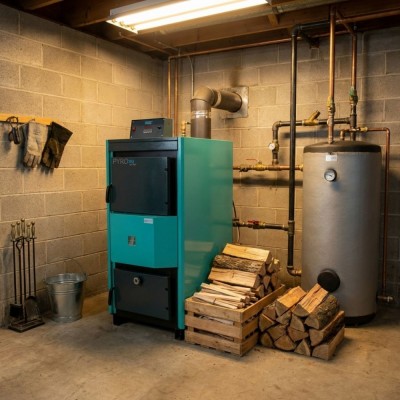
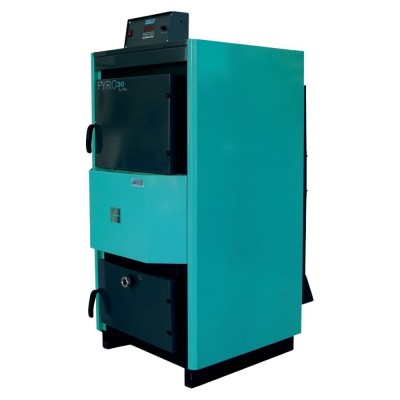




Wood gasification boilers for central heating are the modern choice for economical and environmentally friendly heating of homes, villas, workshops, and industrial buildings. Thanks to the two-stage combustion process, they achieve efficiency rates of up to 92% — significantly higher than traditional solid fuel boilers.
What is a wood gasification boiler for central heating?
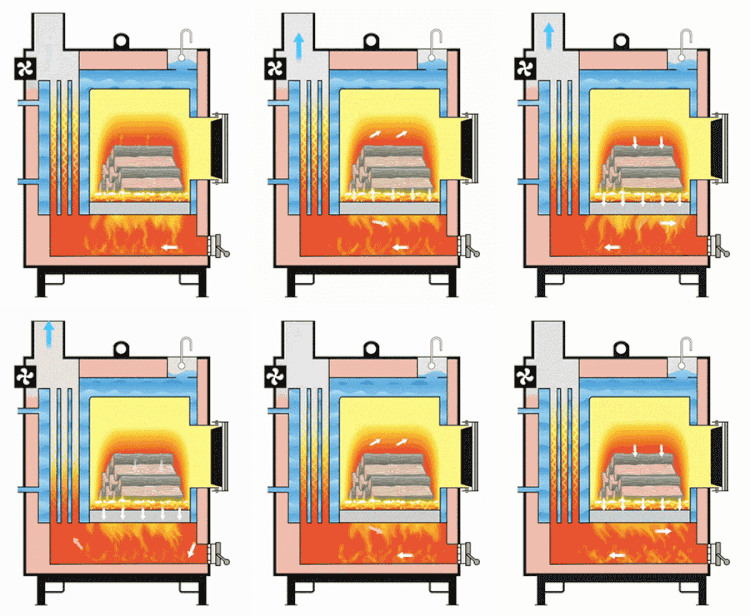
Gasification is a process of thermal decomposition of wood at high temperatures with limited oxygen supply. In a wood gasification boiler for central heating, the wood is first heated and releases combustible gases, which are then completely burned in a second combustion chamber at temperatures above 1000°C. The result is maximum utilization of the energy stored in the wood.
Advantages of wood gasification boilers for central heating
High efficiency — Efficiency between 85% and 92%, which means up to 40% lower wood consumption compared to conventional boilers.
Long burning time — one fuel load provides 8 to 12 hours of continuous operation without constant refueling.
Clean combustion — drastically reduced CO emissions and particulate matter. The models offered by BalkanEnergy.CO.UK in this category comply with the European standard EN 303-5 class 5.
Minimal ash production — up to three times less waste compared to traditional boilers.
Economical operation — firewood remains one of the most affordable fuels on the Bulgarian market, while the high efficiency of the gasification process guarantees maximum return on every euro invested.
Long service life — made of high-quality boiler steel with a thickness of 6–8 mm, these boilers operate reliably for 15–20 years with proper maintenance.
What applications are they suitable for?
We offer wood gasification boilers for central heating with different power outputs — from 30 to 60 kW — suitable for:
- family houses with an area of 100 to 450 m²
- villas and seasonal homes
- workshops and industrial halls
- small hotels and guest houses
- greenhouses and agricultural buildings
What type of firewood should you use?
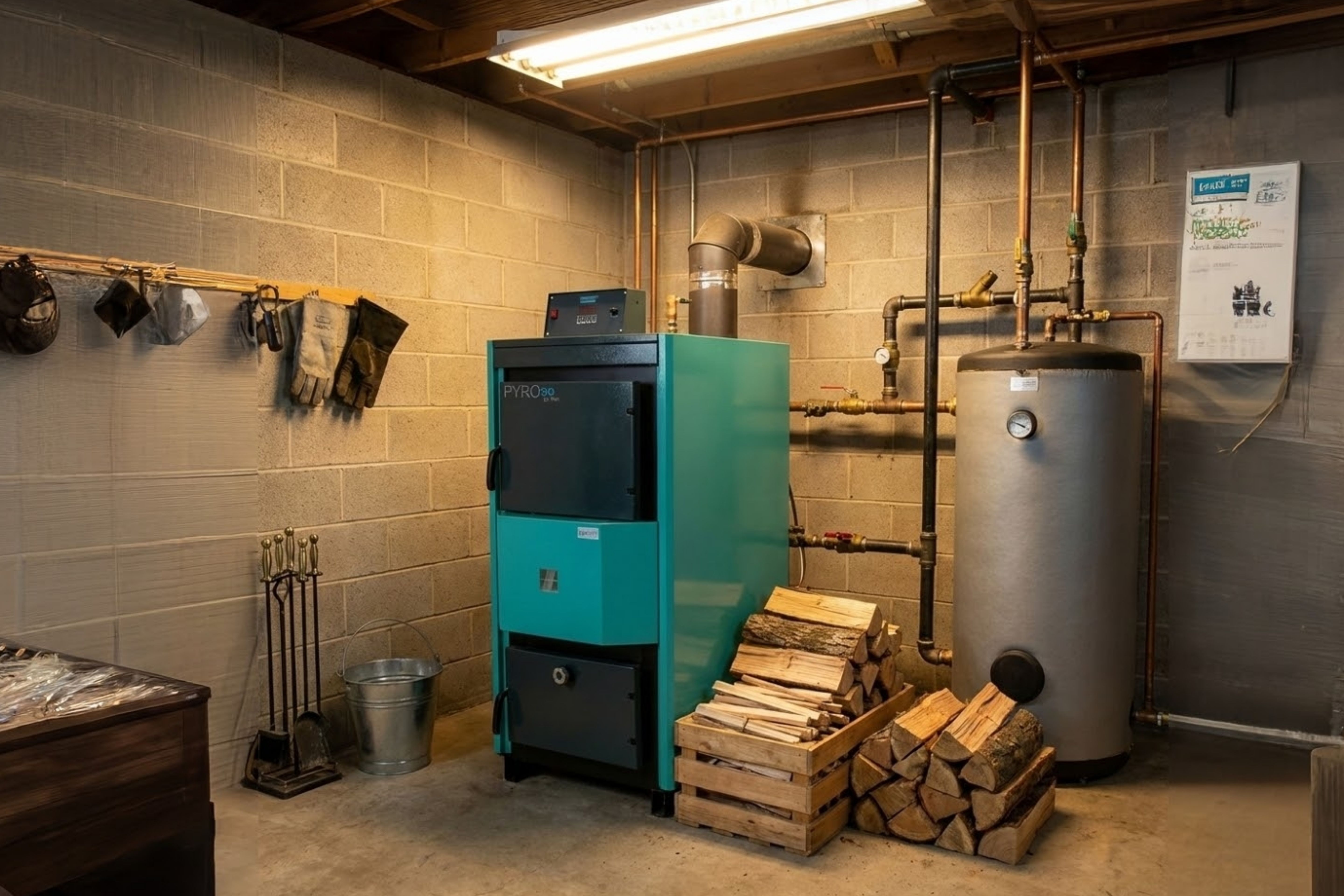
To achieve maximum efficiency from your wood gasification boiler for central heating, use dry firewood with moisture content below 20% — the ideal level is around 15%. The most suitable wood species are hardwoods such as beech, oak, hornbeam, and ash, which have high calorific value. The length of the logs should correspond to the combustion chamber size of your chosen model. Avoid resinous softwood and freshly cut timber — they worsen combustion and contaminate the boiler.
Maintenance of the wood gasification boiler for central heating
Regular maintenance is the key to the long service life and high efficiency of your wood gasification boiler for central heating. Fortunately, it is simple and can easily be performed independently.
Daily (during the heating season), clean the ash from the lower chamber and visually inspect for soot buildup on the door glass. Make sure the fan and regulators are operating properly.
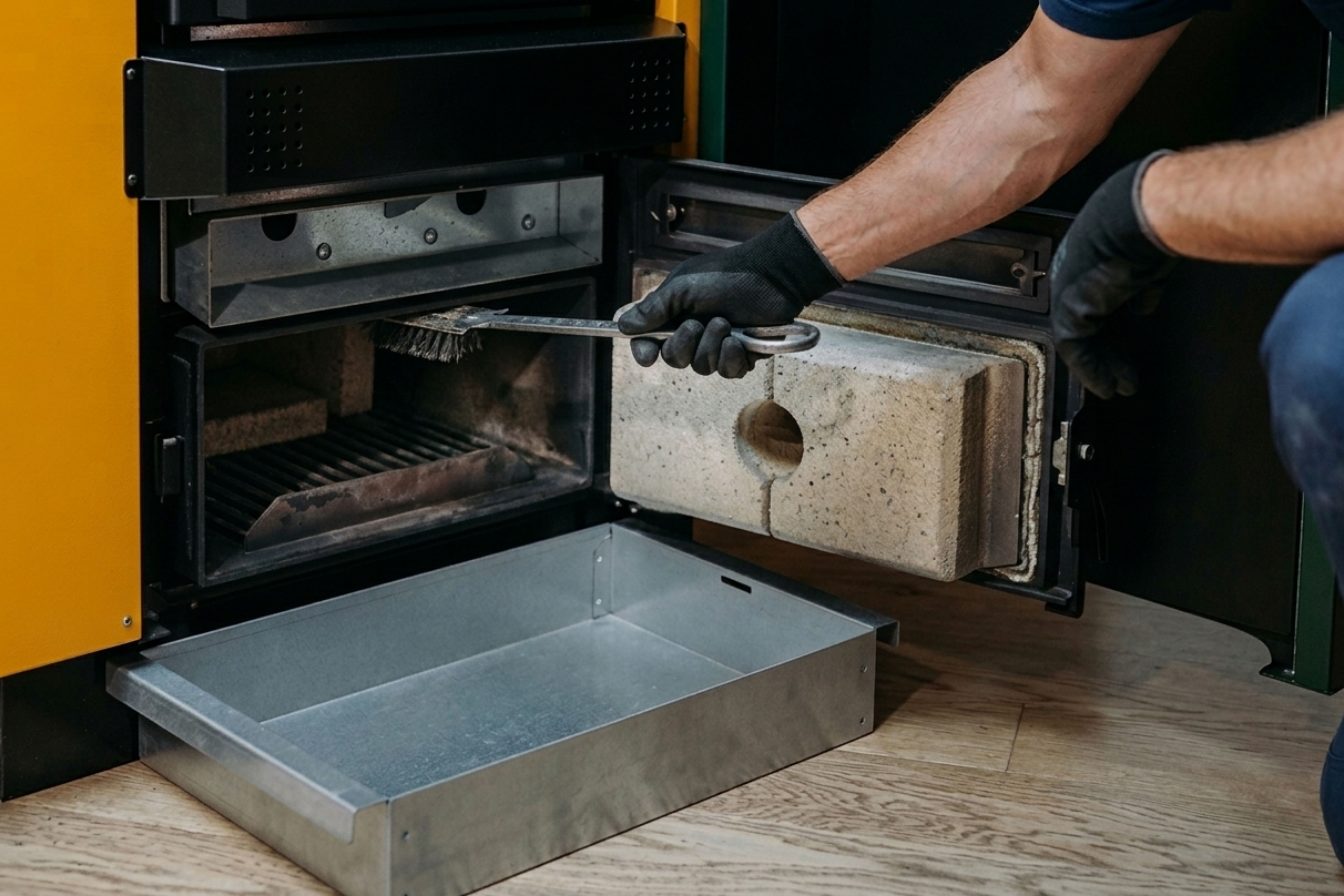
Weekly, clean the combustion chamber and nozzle using the brushes and scraper included in the set. Tar buildup on the nozzle reduces the gasification effect and increases wood consumption. Check the door seals — if damaged, smoke may leak out and efficiency drops.
Monthly, clean the heat exchanger and flue channels from soot. Check the condition of the flue pipe and chimney. For boilers with a buffer tank, check the system pressure (the normal value is between 1.0 and 1.5 bar).
Annually (at the beginning and end of the season), inspect the combustion chamber elements. Perform electronics calibration and replace seals if necessary. Complete chimney cleaning is also recommended.
Tips for a long service life: maintain an operating temperature above 65°C to avoid condensation and acidic corrosion; do not overfill the combustion chamber beyond the marked level; always allow the boiler to complete the burn cycle before shutting it down.
Frequently Asked Questions about wood gasification boilers for central heating
What is the difference between a wood gasification boiler for central heating and a traditional solid fuel boiler?
A traditional boiler burns wood in a conventional way in a single chamber, with efficiency around 60–70%. A wood gasification boiler for central heating works on a two-stage principle — first decomposing the wood into combustible gases under limited oxygen conditions, then burning these gases in a second chamber at over 1000°C. The result is efficiency up to 92%, up to 40% lower wood consumption, and significantly cleaner combustion.
What boiler output do I need for my home?
Approximate calculation — around 1 kW for every 10 m² of heated area in a well-insulated home. For a 150 m² house, a 15–20 kW boiler is suitable; for 250 m² — 25–30 kW; for 400 m² — 40–50 kW. The exact sizing depends on insulation, ceiling height, number of windows, and climate zone. Our team can help you with the calculation.
Is a buffer tank mandatory for a wood gasification boiler for central heating?
A buffer tank is not mandatory, but it is highly recommended and significantly improves boiler performance. It stores excess thermal energy and releases it gradually, extending the time between refueling, increasing efficiency by another 10–15%, and extending boiler life. Recommended volume — approximately 50–75 liters per kW of power.
Can a wood gasification boiler for central heating operate without electricity?
No. Wood gasification boilers for central heating require electricity for the fan (or smoke extractor), electronics, and circulation pumps. In the event of a power outage, the boiler stops normal operation. For areas with unstable power supply, we recommend installing a UPS device or a small generator.
How often should I refuel the boiler?
Depending on the outdoor temperature and insulation — usually 1–2 times per day during active heating mode. With an installed buffer tank, the intervals between refueling are significantly extended, and at moderate temperatures, refueling only once per day may be sufficient.
Can I use the boiler for domestic hot water as well?
Yes. Wood gasification boilers for central heating can be connected to an indirect water heater or a combined buffer tank with integrated DHW production. This is a common solution that allows one system to provide both heating and hot water.
What are the requirements for the boiler room?
The room should have a minimum volume of 15 m³, good natural ventilation (fresh air opening of at least 200 cm²), a non-combustible floor, a chimney with suitable cross-section and draft, and free space around the boiler for maintenance — at least 60 cm at the front and sides. A separate room rather than a built-in living area is recommended.
What are the chimney requirements?
The chimney must provide draft between 15 and 25 Pa, have an appropriate diameter according to the boiler output (usually Ø150–200 mm), be thermally insulated, and not be shared with another heating appliance. The height is usually at least 6–7 meters. The use of a stainless steel chimney or ceramic flue system is recommended.
How often should the boiler be cleaned?
Cleaning ash and the main surfaces is recommended every 3–7 days during active use. Full cleaning of the heat exchanger, flue channels, and nozzle — once per month. Annually, before and after the heating season, full professional servicing is required.
What is the lifespan of a wood gasification boiler for central heating?
With proper operation and regular maintenance — 15 to 20 years. High-quality models made from 6–8 mm boiler steel can last even longer. The most common causes of premature wear are operation with wet wood, low operating temperatures below 65°C (causing condensation corrosion), and irregular maintenance.
Can I install a wood gasification boiler for central heating myself?
Technically, installation is possible for a well-prepared user, but to preserve the warranty and ensure safe operation, we strongly recommend installation by an authorized technician or licensed company. Incorrect installation may lead to warranty loss, poor combustion, or even health hazards.
What is “tar buildup” and how can I avoid it?
“Tar buildup” occurs when the boiler operates at too low a temperature (below 65°C) or with wet firewood. Tar deposits accumulate on the heat exchanger and nozzle, reducing efficiency and potentially clogging the boiler. It can be avoided by maintaining operating temperatures above 65°C, using dry firewood, and installing a buffer tank.